


When your doctor recommends a scan, it’s normal to feel unsure about which one you need. Although many of us follow the doctor’s advice, we do wonder about which scan is better and why they vary so much in cost.
X-ray, CT scan, and MRI scan- even though they’re all imaging tests, they work very differently. Reading this blog will help you know why your doctor chooses one test over another.
Difference Between X-Ray, CT Scan and MRI
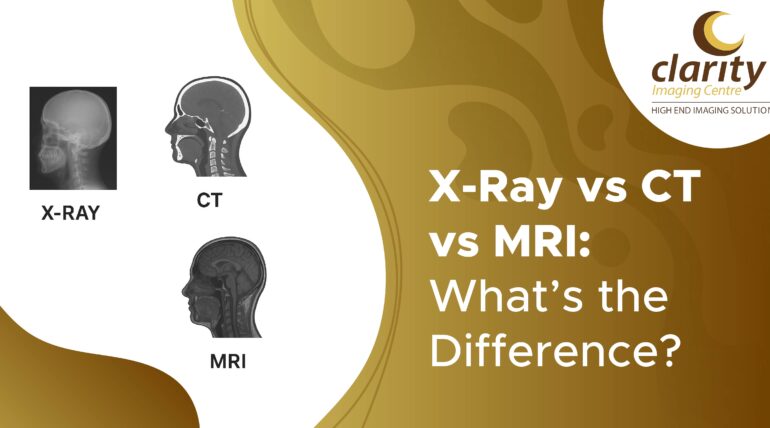
X-rays are the simplest and most often used imaging diagnostics. They are fast, affordable, and helpful in examining bones, fractures, and lung issues. A conventional X-ray scanner uses a small amount of radiation. As X-rays do not reveal soft tissues, they are often the first test your doctor orders when a quick examination is needed.
A CT scan provides a more precise image. Using spinning X-ray technology, it obtains numerous cross-sectional pictures of your body. These slice-like images enable doctors to detect internal bleeding, tumours, infections, and other diseases. A traditional X-ray may miss specific parts.
An MRI scan does not require radiation. It produces very detailed images of your organs and tissues by combining strong magnets and sound waves. MRI is particularly beneficial for analysing soft tissues such as the brain, nerves, muscles, and ligaments. This allows doctors to understand complex conditions in your body better.
How Each Scan Works
If you want to compare X-ray, CT, and MRI scans, the most significant distinction lies in how each produces images.
X-Rays
X-rays emit a small amount of radiation throughout your body. Dense sections, such as bones, absorb more radiation, making them look white in images. It’s a simple and quick process.
Computed Tomography (CT)
CT scans use radiation, but in a much more advanced manner. The CT scanner rotates while capturing multiple images. These images are merged to create a three-dimensional view of your body.
Magnetic Resonance Imaging (MRI)
MRI scans do not use radiation. Instead, they produce detailed images by reacting with the hydrogen atoms within your body. The magnets and energy pulses enable the machine to record layers and textures that even CT scans cannot uncover.
Uses of each scan- X-Ray vs CT vs MRI
Let’s look at the specific applications of each scan to get more clarity.
| SCAN TYPE | BEST FOR | WHY IS IT USED |
| X-Ray | FracturesDental issuesChest infections | Provides quick, basic imaging for bones and lungs. |
| CT Scan | Abdominal painSinus problemsTumours or cancers | Offers clearer, detailed images and is fast, making it useful in emergencies. |
| MRI Scan | Brain-related issuesSpine problemsLigament tearsNerve damage | Gives exact soft-tissue images without radiation. |
Understanding the Procedures of X-ray, CT, and MRI
Each test is different, but the process is easier than most people expect.
The quickest method is an X-ray, which requires you to stand or lie still for a moment while the image is taken. A CT scan feels similar, but it uses a rotating scanner that circles you and often takes only a few minutes.
An MRI takes slightly longer and feels enclosed since you lie within a tunnel-like machine. This is perfectly normal and part of the MRI procedure, which employs powerful magnets to capture detailed images. The mri scanner emits loud tapping sounds, so you’ll be given ear protection to keep you comfortable during the scan. Doctors confirm the seriousness of your issue, with MRI being the last option.
Accuracy & Safety of These Scans
When it comes to accuracy and precision, each scan has its own advantage. X-rays are excellent for bones, CT scans provide clear cross-sectional views in emergencies, and MRI delivers the most information for soft tissues. One significant benefit of MRI over CT is that it produces precise images without using radiation, making it safer for repeat examinations and sensitive areas such as the brain, nerves, and joints. Regardless of which scan your doctor decides on, each is intended to diagnose safely and effectively, tailored to your individual health needs.
Also read: https://www.clarityimaging.in/pet-scan-vs-ct-scan/
Choosing the Right Scan for Your Symptoms
Knowing which scan is best for your case makes the entire procedure less stressful. Each test offers unique benefits; therefore, the best option is determined by your doctor’s aim.
If you have a concern about a fracture, a chest infection, or dental pain, you should typically start with an X-ray. It helps your doctor determine whether further detailed imaging is required.
A CT scan is advised for more complex symptoms, such as stomach discomfort, head injuries, suspected internal bleeding, or lump formations. It produces rapid, detailed images, making it particularly useful in critical situations.
An MRI scan is the ideal option for inspecting soft tissues in detail. So, whether you experience joint pain, nerve-related symptoms, dizziness, brain fog, or ligament or tendon damage, an MRI can help doctors better understand what’s going on.
And if you’re planning to book any of these tests, choose a trusted MRI scan centre in Coimbatore, which helps ensure accuracy and proper guidance throughout your visit.
Conclusion
Knowing the differences between an MRI, CT scan, and X-ray makes selecting the appropriate imaging test much simpler. When you understand what each scan performs and why your doctor recommends it, you will feel more secure and prepared when entering the scanning room.
Frequently Asked Questions
1. Why do doctors prefer a CT scan over an MRI?
CT scans are faster and more useful during emergencies.
2. Which is costly, CT or MRI?
MRI is generally more expensive.
3. What do I wear for an MRI?
Wear comfortable clothing without metal, but you may be asked to change into a gown.
4. How close is the MRI tube to your face?
The distance between your face and the MRI tube varies depending on the machine type up to 12 inches of clearance.
5. Can I bring my phone to an MRI?
No, MRI machines use strong magnets, so metal objects aren’t allowed.
6. What MRI cannot detect?
MRI cannot clearly detect tiny calcium, fine bone details, or fast-moving areas.
7. What cannot be detected by a CT scan?
CT scan cannot show soft tissues, small ligament injuries, or early nerve changes.
8. Which is better, MRI or CT scan?
MRI is better for soft tissues; CT is better for bones and quick emergency checks.
9. Which is better, MRI or CT scan for the brain?
MRI is better for brain detail; CT is used first to check bleeding in emergencies.


