

Quick Answer
Carotid Doppler ultrasonography is a safe, non-invasive diagnostic test that uses sound waves to measure blood flow through the carotid arteries in your neck. Doctors recommend it for detecting plaque formation, arterial constriction, and stroke risk. The test lasts 20-30 minutes, involves no preparation, and emits no radiation. The results serve to guide timely treatment options.
Quick Overview Table
| Aspect | Key Information |
| What it scans | Carotid arteries in the neck for blood flow and blockages |
| Why is it done | Stroke risk, TIA, plaque, hypertension, and diabetes monitoring |
| Who needs it | Adults with dizziness, high BP, heart disease, or a history of stroke |
| How it works | Sound waves + Doppler probe; measures velocity and flow patterns |
| Duration | 20 to 30 minutes; no pain, no needles, no radiation |
| Key report terms | PSV, EDV, stenosis %, ICA/CCA, plaque, intima-media thickness |
Table of Contents
- Introduction
- What Is Carotid Doppler?
- Why Doctors Recommend Carotid Doppler
- Who May Need This Test
- How the Test Works
- Preparation Before the Scan
- Carotid Doppler Procedure Step by Step
- Understanding Carotid Doppler Results
- Carotid Doppler Normal Values and Report Terms
- Carotid Doppler Test Cost and Availability
- Safety, Risks and Benefits
- When to Consult a Doctor After the Test
- Conclusion
- FAQs
Introduction
Carotid Doppler ultrasonography has become one of the most popular diagnostic tests for vascular health, and with good cause. Every year, millions of patients in India are referred for this basic test to understand better what is happening in their neck arteries.
This guide will explain all you need to know about the scan, including how the results are interpreted.
What Is Carotid Doppler?
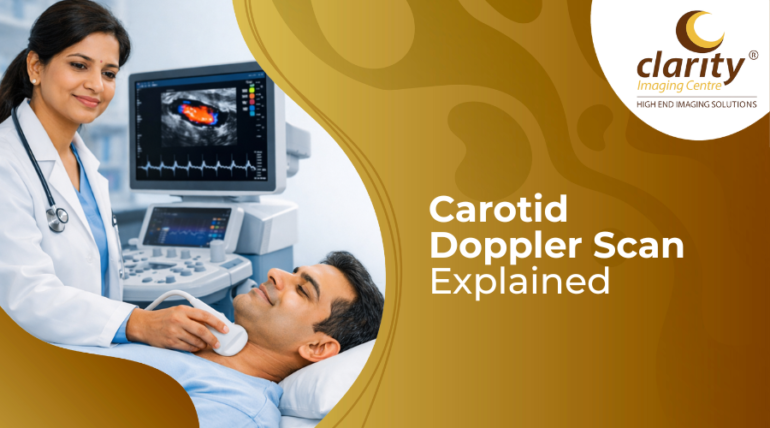
The carotid artery Doppler is a diagnostic imaging test that uses standard ultrasound and Doppler technologies to visualise and measure blood flow in the carotid arteries, two major vessels running along either side of the neck that supply blood to the brain. The Doppler effect detects movement in blood cells and turns it into colour maps and velocity data that appear on a monitor.
Why Doctors Recommend Carotid Doppler
The most common reasons are:
- Assessing stroke and transient ischaemic attack (TIA) risk
- Detecting plaque and carotid artery stenosis
- Monitor patients with diabetes, hypertension, or high cholesterol
- Evaluation of an audible bruit (abnormal sound) across the carotid artery
- Pre-operative planning for heart or vascular surgery
- Follow-up imaging following carotid stenting or endarterectomy
Who May Need This Test
The bilateral carotid Doppler test is advised for people who suffer from any of the following:
| Symptom / Condition | Why the Scan Is Needed |
| Dizziness or sudden weakness | May signal reduced brain blood flow |
| Blurred or transient vision loss | Could indicate carotid blockage or TIA |
| Prior stroke or mini-stroke | Baseline and follow-up vascular assessment |
| Heart disease or atrial fibrillation | Systemic vascular risk evaluation |
| Smoking history (10+ years) | Accelerated plaque development risk |
| Diabetes with poor glucose control | Vascular complication surveillance |
How the Test Works
A small handheld transducer (probe) is applied to the skin of the neck. It produces high-frequency sound waves that bounce off red blood cells passing through the artery. A computer analyses the returning echoes to calculate
- Blood flow velocity (speed at various moments during the cardiac cycle)
- Direction of flow and reversal patterns
- Wall thickness and plaque properties
- Degree of narrowing (stenosis percentage)
Colour Doppler overlays red and blue maps on the grey-scale image, with red representing blood flowing towards the probe and blue representing flow moving away, making it simple to identify turbulence or obstruction at a glance.
Also read: https://www.clarityimaging.in/doppler-scan/
Preparation Before the Scan
One advantage of a carotid Doppler exam is that it requires little to no preparation. However, a few easy steps will make the procedure go smoothly:
- Wear relaxed, comfortable attire with an open, low collar
- Remove necklaces, chains, and earrings before you arrive
- Do not use lotions, oils, or powder on the neck area
- Inform the technician about any medications you’re currently taking
- Continue with regular meals and water unless otherwise told by the lab
Carotid Doppler Procedure Step by Step
The USG carotid Doppler operation is rapid and usually takes 20-30 minutes. Here’s what to expect:
- Registration
- Positioning
- Gel application
- Scanning
- Bilateral assessment
- Completion
Understanding Carotid Doppler Results
A carotid Doppler report includes pictures, velocity measurements, and written findings. Your radiologist will evaluate:
- Intima-media thickness (IMT) an indication of early vessel wall thickening
- presence, size, and type of plaque (soft, mixed, or hardened)
- Degree of stenosis: mild (<50%), moderate (50-69%), severe (70-99%), or occlusion
- The peak systolic velocity (PSV) and end diastolic velocity (EDV) in each section
- Resistive index to assess downstream vascular resistance
Carotid Doppler Normal Values and Report Terms
Here is a plain-language guide to the most popular terms:
| Term / Abbreviation | Plain-Language Meaning | Typical Normal Range |
| CCA (Common Carotid Artery) | The main carotid artery before it divides | PSV: 60–90 cm/s |
| ICA (Internal Carotid Artery) | The branch supplying blood to the brain | PSV: 40–80 cm/s |
| ECA (External Carotid Artery) | The branch supplying the face and scalp | PSV: 70–130 cm/s |
| PSV (Peak Systolic Velocity) | Fastest blood speed during heartbeat | Varies by segment |
| EDV (End Diastolic Velocity) | Slowest speed between heartbeats | Elevated = stenosis risk |
| Stenosis % | Percentage of artery narrowing | Normal: <50% |
| IMT | Thickness of artery wall layers | Normal: <0.9 mm |
Carotid Doppler Test Cost and Availability
The cost of a carotid Doppler test in India varies by city, facility type (government hospital vs private diagnostic centre), and whether one or both arteries are scanned. Carotid Doppler tests are normally priced between ₹1,500 and ₹4,500 at certified centres, with higher rates in metropolitan areas. Many hospitals offer this scan as part of a combined cardiac or neurological health package.
To find a reliable facility, look for a recognised ultrasound scan centre in Coimbatore or your neighbouring city that is accredited by NABL or NABH for quality assurance. Always confirm with the centre if the report includes a radiologist’s opinion.
Safety, Risks and Benefits
Key points include:
- Radiation
- Invasiveness
- Side effects
- Recovery time
- Contrast agents
- Duration
The advantages of early detection outweigh any inconvenience. Detecting even minor carotid artery stenosis Doppler alterations enables doctors to treat with antiplatelet drugs, statins, or lifestyle changes before a major incident occurs.
When to Consult a Doctor After the Test
Contact your doctor right away if the carotid doppler report shows any of the following:
- Moderate to severe stenosis (more than 50-70% narrowing)
- Large, unstable (hypoechoic) plaque with an irregular surface
- Significantly increased PSV, indicating haemodynamically considerable obstruction
- Absence or reversed vertebral artery flow
Disclaimer
The information in this article is meant solely for educational awareness and general information. It is not intended to replace professional medical advice, diagnosis, or treatment. Always consult a qualified healthcare professional or doctor regarding any medical condition or health concern.
Conclusion
A Carotid Doppler ultrasound is a straightforward, safe, and informative examination that is essential for monitoring cardiovascular and neurological health. A timely diagnosis can make all the difference in averting a life-changing stroke, so if your doctor has ordered this test, consider it a proactive step toward long-term well-being.
Book your Carotid Doppler ultrasound today and take a simple, safe step toward protecting your heart and brain health.
FAQs
1. What is a Carotid Doppler test?
A Carotid Doppler test is an ultrasound examination used to monitor blood flow through the carotid arteries in the neck.
2. Why is a Carotid Doppler ultrasound done?
Carotid Doppler ultrasound is used to detect stenosis, blockages, and plaque buildup in the carotid arteries..
3.Is a Carotid Doppler test painful?
No, a Carotid Doppler test is painless, non-invasive, and does not involve any injections.
4. What are normal values in a Carotid Doppler report?
A typical Carotid Doppler report demonstrates smooth blood flow with no substantial constriction or obstruction of the vessels.
5. How long does a Carotid Doppler ultrasound take?
A Carotid Doppler test is an ultrasound examination used to monitor blood flow through the carotid arteries in the neck.
6. Can Carotid Doppler detect stroke risk?
Carotid Doppler ultrasound is used to detect stenosis, blockages, and plaque buildup in the carotid arteries.
7. What happens if the Carotid Doppler result is abnormal?
No, a Carotid Doppler test is painless, non-invasive, and does not involve any injections.
8.What is the cost of a Carotid Doppler test in India?
A typical Carotid Doppler report demonstrates smooth blood flow with no substantial constriction or obstruction of the vessels.


