

Medical imaging has changed how doctors diagnose and treat digestive and biliary problems. MRCP is a modern diagnostic method and is essential for evaluating the bile ducts, pancreas, and gallbladder without invasive procedures. If your doctor has recommended this scan, understanding its purpose and procedure will help you feel more confident and prepared. This guide provides all you need to know simply and reassuringly.
The MRCP test is a specialised imaging scan that examines the bile ducts, pancreatic ducts, liver, and gallbladder. It is a safe, noninvasive procedure that does not require the insertion of surgical instruments into the body. Doctors frequently recommend it when they need detailed images of the digestive tract to detect obstructions, stones, inflammation, or tumours.
What is an MRCP Test?
The Magnetic Resonance Cholangiopancreatography (MRCP) test is an MRI scan that focuses on the bile and pancreatic duct systems. An MRCP scan generates high-resolution images using magnetic fields and radio waves, enabling surgeons to visualise internal structures without Ionising Radiation.
Purpose of the MRCP Test
Many people question, “Why do I need an MRCP scan?”
Doctors recommend this imaging test when symptoms like abdominal pain, jaundice, nausea, or abnormal liver function tests indicate bile duct or pancreatic problems.
The scan identifies:
- Blockages
- Narrowed ducts
- Infections
- structural abnormalities
It is very beneficial for examining the MRCP abdomen parts in depth.
Conditions Diagnosed
The following table highlights common MRCP indications and their purpose:
| Condition | Purpose of Diagnosis |
| Gallstones in the bile ducts | Detect obstruction |
| Pancreatic inflammation | Identify pancreatitis |
| Bile duct strictures | Assess narrowing |
| Tumours | Detect abnormal growth |
| Congenital abnormalities | Identify structural defects |
When ultrasound results are inconclusive, an MRCP scan for gallstones is typically performed.
Doctors may also use MRCP to examine the gallbladder and assess the surrounding organs.
Procedure Overview
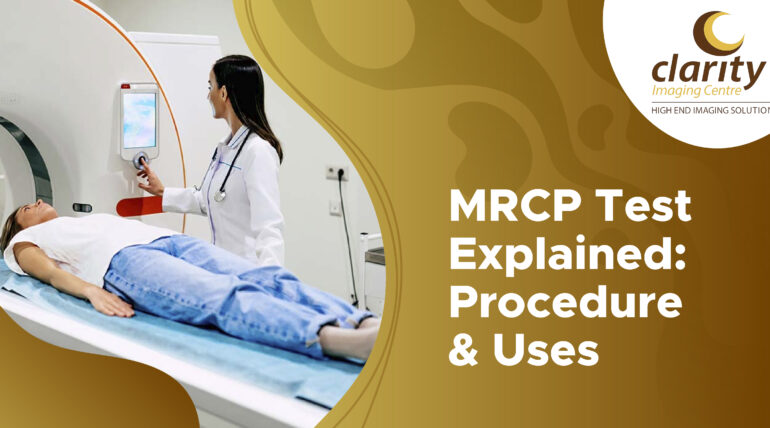
The MRCP treatment is straightforward and painless. During the scan:
- You recline on a sliding table.
- The table enters the MRI scanner.
- Images are obtained without the use of surgical equipment.
Unlike some endoscopic procedures, this test does not involve the introduction of devices into the digestive tract.
Preparation Before the MRCP Test
Preparation is typically simple.
- Patients are often asked to fast for four to six hours before the scan to obtain sharper images of the biliary system.
- You should notify your doctor of any implants, pacemakers, or metal devices in your body.
- Comfortable, metal-free clothing is recommended.
The cost of an MRCP test varies by diagnostic centre and area; it’s usually around Rs 4500 to 6500 and it is less expensive than invasive treatments.
Check out our charges for various MRCP procedures.
What Happens During the Scan
Many patients enquire, “How is the MRCP performed?”
- During the process, keep still within the MRI machine.
- The scan normally lasts 20 to 45 minutes.
- You might hear tapping or humming sounds.
In rare cases, contrast dye can be employed to improve image clarity.
A reputable MRI scan centre in Coimbatore ensures patient comfort and safety throughout the operation.
Benefits of the MRCP Test
The MRCP test provides various advantages:
- Non-invasive imaging
- No ionising radiation exposure
- High-resolution visualisation
- An accurate diagnosis
- Minimal preparation required
MRCP anatomy images enable physicians to analyse the bile and pancreatic duct structures clearly.
The distinction between ERCP and MRCP is that MRCP is a diagnostic procedure that does not involve instrument insertion into ducts.
Risks & Safety Considerations
MRCP is generally considered safe for most patients.
Possible concerns include:
- Mild allergic reaction to contrast dye
- Temporary discomfort while lying still
- Caution is required for patients with certain implants
Since it uses magnetic fields instead of radiation, it eliminates the hazards associated with X-ray exposure.
Result Interpretation
After the scan:
- A radiologist scrutinises the photographs attentively.
- A full report has been created.
- The findings are discussed with your doctor.
Possible findings may include:
- Gallstones
- Obstructions
- Tumours
- Inflammation
Further treatment decisions depend on these results.
After the Test
There is usually no recovery period following the MRCP test.
After completion,
- You can resume normal activities.
- If you use a contrast, drink some water.
- Follow your doctor’s guidance on future steps.
Most patients return home shortly following the operation.
When is MRCP Recommended?
Doctors typically recommend this imaging test in the following situations:
| Symptom / Condition | Reason for Recommendation |
| Persistent abdominal pain | Evaluate bile ducts |
| Unexplained jaundice | Detect obstruction |
| Recurrent pancreatitis | Assess duct condition |
| Abnormal liver tests | Identify structural issues |
| Nonconclusive ultrasound results | Obtain detailed imaging |
When other tests fail to provide adequate clarity, our imaging approach does.
Conclusion
The MRCP test is a safe, dependable, and patient-friendly imaging procedure for diagnosing bile duct, pancreatic, and gallbladder disorders. It provides precise intraoperative images with minimal preparation and no recovery time, enabling surgeons to make more accurate decisions. If your doctor recommends this scan, you can be confident that it will produce precise results while prioritising your comfort and safety.
FAQs
1. Is an MRCP test painful?
No, it’s not painful. It’s a non-invasive scan that requires you to lie still.
2. What is the cost of an MRCP scan?
The cost varies by hospital and city, but the diagnostic centre and the use of contrast media primarily determine it.
3. Is MRCP done on an empty stomach?
Yes, patients are normally asked to fast for 4-6 hours before the scan to provide sharper images.
4. MRCP test side effects?
MRCP is extremely safe. Side effects are uncommon; some individuals may experience minor discomfort or a rare allergic reaction if contrast dye is used.
5. What is the recovery time for MRCP?
There is no recovery time required. You can resume normal activities soon following the scan.
6. Which is better, a CT scan or an MRCP?
It depends on the situation. MRCP is superior for detailed imaging of the bile and pancreatic ducts, but CT scans are better for overall abdominal examination. Your physician will determine the best course of action.


